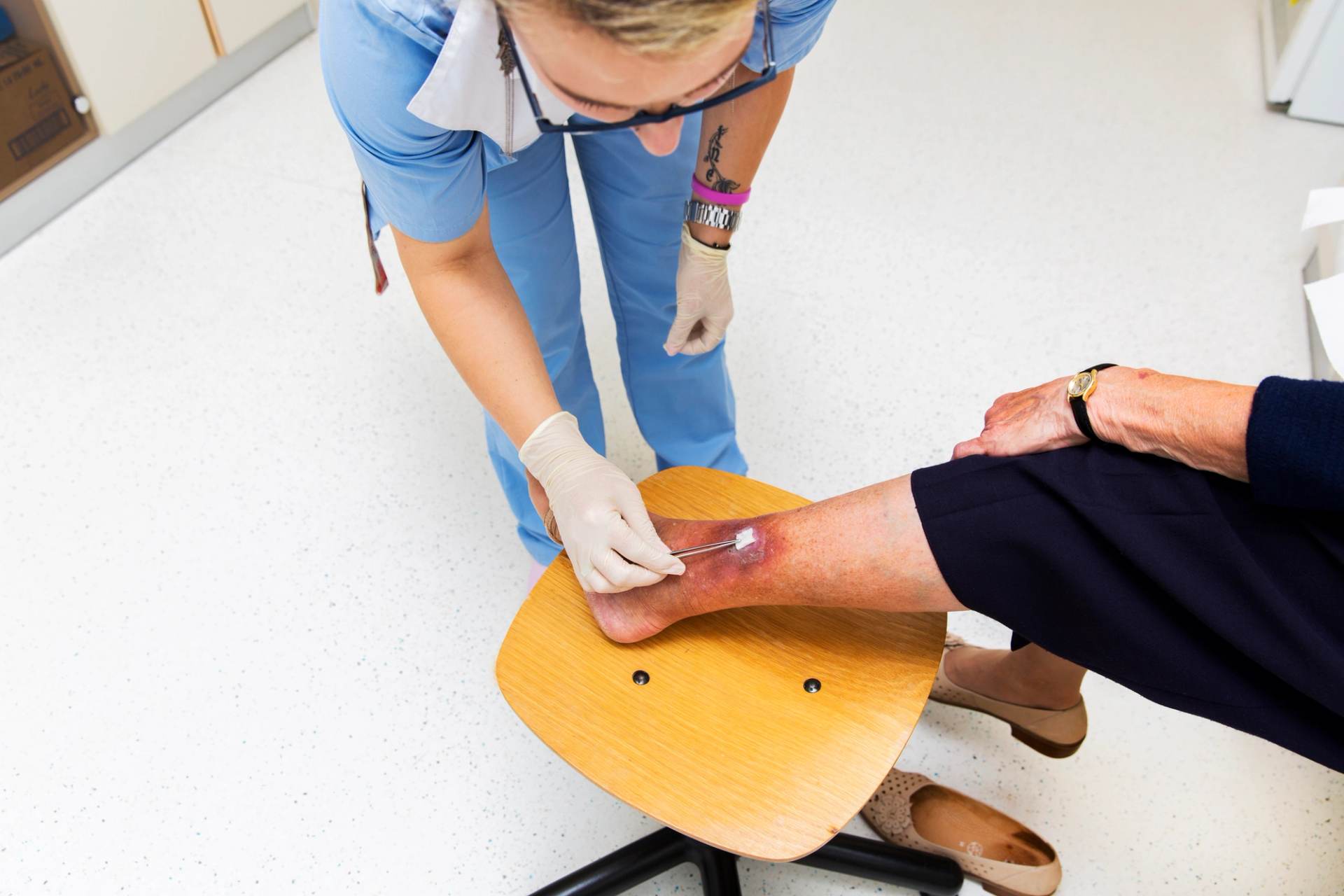
Wounds: how to reduce workload and improve care
Jennifer Townsend MSc, PG Dip, BN, Dip HE PCN, Tissue Viability Nurse Specialist Chester Le Street Primary Care Network
Practice Nurse 2026;56(5):17-20
Routine wound reviews remain deeply embedded in general practice, yet they often reflect tradition rather than evidence. But how can nurses safely reduce routine reviews while improving outcomes?
Wound care is still a familiar fixture in some practices – but increasingly, it represents a model of care that is difficult to justify. At a time of rising demand, workforce pressure, and shifting NHS policy, this model is increasingly unsustainable. Patients often attend several times a week for routine dressing changes, yet outcomes remain variable and workload continues to rise.
For patients, this model is not without cost. Frequent attendance at GP practices can disrupt daily life, requiring time away from work, reliance on carers or transport, and repeated engagement with services that may not demonstrably improve healing. At a time when healthcare systems are striving to deliver more person-centred care, this raises an important question: are we designing wound care around service convenience, or around patients’ lives?
Wound care affects millions of patients and costs the NHS billions annually, with the majority delivered in community settings.1 At the same time, general practice is under sustained pressure, with finite workforce capacity expected to manage growing demand.2
It is no longer enough to ask how we review wounds. We must ask why we are still doing it this way – and who the current model truly serves. This article argues for a decisive move toward supported self-management and patient empowerment, drawing on emerging evidence, UK policy, and the NMC Code, and challenges the assumption that frequent clinician contact equates to high-quality care.
Policy context: the direction is clear
The move toward supported self-management is not an innovation – it is policy. The NHS Long Term Plan3 and the Universal Personalised Care Model4 emphasise:
- Shared decision-making
- Supported self-management
- Reduction in avoidable appointments.3,4
In the context of wound care, the National Wound Care Strategy Programme (NWCSP)5 calls for improved outcomes alongside reduced burden on both patients and services. In addition, NHS England standards now explicitly incorporate supported self-management as part of routine wound care pathways.6-8
The expectation is clear: patients should be active participants in their care.
The myth of the routine review
Routine wound review is often equated with safe, high-quality care. However, this assumption does not hold up under scrutiny.
Adherence to key treatments – particularly compression therapy – remains low, ranging from 12–52%, despite frequent nurse contact.9
This highlights a fundamental issue: You cannot review your way to healing—wound care happens between appointments.
Healing depends on what patients do day-to-day. Without understanding, engagement, and consistency, repeated clinic attendance alone does not improve outcomes.
The hidden burden: the impact of frequent GP attendance on patients
While routine wound reviews are often justified as reassuring or safe, the wider impact on patients of frequent attendance at GP practices is often underestimated.
For many individuals, particularly those of working age, attending appointments several times per week can significantly disrupt daily life. This may involve time away from work, reduced income, or the need to disclose health needs to employers. The NHS Long Term Plan3 explicitly recognises the need to reduce unnecessary appointments and minimise disruption to people’s lives, highlighting the importance of delivering care in ways that are more convenient and person‑centred.
Appointment timing further compounds this burden. Limited clinic capacity and inflexible scheduling often require patients to organise their lives around care rather than integrating care into their daily routines. This may involve arranging transport, depending on family or carers, or navigating waiting times – factors that disproportionately affect individuals with mobility issues, financial constraints, or limited social support.
The Universal Personalised Care Model emphasises that care should be designed around what matters to the individual, including their ability to live independently, maintain employment, and manage their own health within the context of everyday life.4 Frequent, clinician-led wound reviews can be at odds with this approach, reinforcing service dependency rather than enabling autonomy.
There is also a cumulative psychological and practical impact. Repeated attendance can lead to ‘treatment fatigue,’ where the effort of attending outweighs perceived benefit, contributing to reduced engagement or non-attendance. Some patients may subsequently choose to self-manage without appropriate support – a pattern already recognised within wound care populations.
In contrast, supported self-management enables care to be delivered in the context of the patient’s own life. By reducing avoidable appointments and promoting flexibility, this approach not only aligns with NHS policy but also reduces the logistical, socioeconomic, and emotional burden associated with repeated healthcare access.
Self-management: already happening, rarely supported
Self-management is a cornerstone of chronic disease care, yet its application in wound care remains inconsistent.
Activities such as dressing changes, skin care, limb elevation and exercise can all be undertaken by patients when appropriately supported.10
Importantly, patients are already doing this.
Studies show many individuals self-treat wounds – often driven by convenience or independence – but frequently without adequate education or oversight.11
This is the gap:
- Patients are already self-managing
- But systems are not consistently supporting them to do so safely
Why empowerment matters
Patient empowerment is associated with improved adherence, satisfaction, and outcomes. In wound care, it enables patients to:
- Build confidence
- Understand treatment
- Adapt care to daily life
- Take ownership of healing.12, 13
Wound care is not a clinical event – it is a daily lived experience.
Why letting go feels risky: the ‘PIN number’ dilemma
Despite this, many nurses hesitate to reduce routine reviews.
The barrier is not knowledge – it is fear.
Fear of:
- Patient harm
- Missed deterioration
- And ultimately, professional accountability
This often manifests as concern about the impact on one’s NMC registration (‘PIN number’).
This concern is entirely valid. Wound care carries risk.
However, frequent review does not remove that risk – it often creates a false sense of safety. Because the reality is that most wound care happens outside the clinic.
Reframing risk through the NMC Code
The NMC Code14 provides a clear framework for safe practice. It requires nurses to:
- Prioritise people, putting the needs of patients first
- Practise effectively, delivering high-quality, evidence-based care, communicating well and maintain skills through education
- Preserve safety through appropriate risk assessment and escalation
- Promote professionalism and trust through accountability, acting with honesty and integrity and keeping clear and accurate records
In this context, safe care is not defined by frequency of review, but by whether the nurse has:
- Assessed the patient appropriately
- Provided clear information and education
- Enabled informed decision-making
- Established robust safety-netting
- Documented all of the above
The critical shift is not Did I see the patient often enough? but Did I enable them to manage safely?
Documentation: the cornerstone of safe self-management
Confidence in reducing wound reviews is directly linked to confidence in documentation.
Robust documentation demonstrates that care has been:
- Assessed appropriately
- Clearly explained
- Agreed collaboratively
- Supported with safety-netting
Key components should include:
- Suitability for self-management
- Education provided (e.g. dressing technique, compression)
- Agreed care plan
- Explicit escalation advice
- Patient understanding and consent
Given that many patients already self-treat without adequate knowledge, recording what has been taught is essential.11
Documentation is not an administrative burden, it is professional protection.
Who needs to do the care: a question we are avoiding
Alongside how often wounds are reviewed sits another equally important question: who actually needs to deliver wound care?
In many services, routine dressing changes remain the domain of registered nurses – even when clinical complexity is low.
This raises important considerations:
- Does every dressing require a nurse?
- Could care be delivered by healthcare assistants in some cases? Or, more importantly
- By patients themselves?
This is not simply a workforce debate. It reflects a deeper issue: an assumption that more professional input equals better care.
The most effective model is one where care is:
- Matched to clinical need
- Supported by appropriate oversight
- Focused on building patient capability
Supported self-management is not a compromise – it is often the most person-centred and sustainable approach.
A practical framework for reducing wound reviews safely
- Risk stratification: Identify suitable patients using holistic assessment
- Education: Build patient capability early
- Care planning: Provide clear, structured guidance
- Safety-netting: Ensure patients know when and how to seek help
- Planned follow-up: Replace routine visits with need-based review
- Role reframe: Nurse as educator, assessor, and partner
Reassurance: safe care is not the same as frequent care
The belief that more contact equals safer care is deeply ingrained – but incorrect.
Safe care is delivered through:
- Clinical judgement
- Patient understanding
- Clear escalation pathways
- Robust documentation – not repetition alone.
Continuing high-frequency review without building patient capability risks:
- Ongoing dependency
- Poor adherence
- Reduced service capacity
Conclusion: the courage to practise differently
Letting go of routine wound review is not about reducing care – it is about improving it. Supported self-management aligns with NHS policy, the NMC Code, and evidence from chronic disease management.
It also aligns more closely with the realities of patients’ lives. Reducing unnecessary appointments lessens the disruption associated with repeated GP attendance – minimising time away from work, reducing reliance on others, and enabling care to fit around daily living rather than dominate it. This shift is not only clinically appropriate but fundamentally person-centred.
With appropriate assessment, education, safety-netting, and documentation, this approach is not a professional risk.
It is professional practice at its best.
The measure of success is not how often we see patients— but how well they manage when we are not there, and how well care fits into the lives they are trying to live.
KEY PRACTICE POINTS |
|
References
- Stephen-Haynes J, Toner L. Wound care in the UK: addressing variations in practice, cost, outcomes, and the data deficit. Br J Nurs 2025;34(20)(Suppl).S4-S10
- Kapp, S. and Santamaria, N. (2017). How and why patients self-treat wounds. Int Wound J. https://onlinelibrary.wiley.com/doi/epdf/10.1111/iwj.12796
- NHS England. The NHS Long Term Plan (V 1.2); 2025. https://www.england.nhs.uk/long-term-plan/
- Sanderson J, Kay N, Watts R. NHS England. Universal Personalised Care Implementing the Comprehensive Model; 2019 https://www.england.nhs.uk/wp-content/uploads/2019/01/universal-personalised-care.pdf
- NHS England (2023). Wound Care Information Standard; 2023 Wound Care Information Standard - NHS Standards Directory https://standards.nhs.uk/published-standards/wound-care-information-standard
- Parfitt G, Blackburn J, Ousey K. Exploring concepts and current evidence of shared and self-care in the management of lower limb wounds. Wounds UK. 2021;17(4): 36-44
- Blackburn, J. and Ousey, K. Patient and staff experience of supported self-management information and education for lower limb wound care during a pandemic. Wounds UK. 2023;19(02):16-24.
- Ross B. How medical technology can enhance patient self-management in wound care. Practice Nurse 2023;53(4):12-15.
- Werdin F, Tennenhaus M, Schaller HS, Rennenkampf H-O. Evidence-based Management Strategies for Treatment of Chronic Wounds. Eplasty 2009;4(9):169-179.
- Couch K. Innovations in Wound Care Research – Patient centered outcomes and real world evidence. Alliance of Wound Care Stakeholders; 2026. https://www.woundcarestakeholders.org/about/value-of-wound-care/research/innovations-in-wound-care-research-patient-centered-outcomes-and-real-world-evidence
- Gethin G, Probst S, Styrja J, et al. Evidence for person-centred care in chronic wound care: A systematic review and recommendations for practice, J Wound Care 2020; 29(Sup9b):S1-22
- Moore Z. Patient empowerment in wound management. Wounds UK 2016;11(1):32-35.
- Hackert B, Weger U, Stüermer EK. Empowerment in chronic wound care—exploring the scope for patient contribution. Front Nurs 2024;11(1):1-16.
- Nursing and Midwifery Council. The Code; 2018. https://www.nmc.org.uk/standards/code/
Related articles
View all Articles